

Key Takeaways
- If you expect to owe $1,000 or more in federal tax, the IRS requires you to make quarterly estimated payments rather than waiting until April.
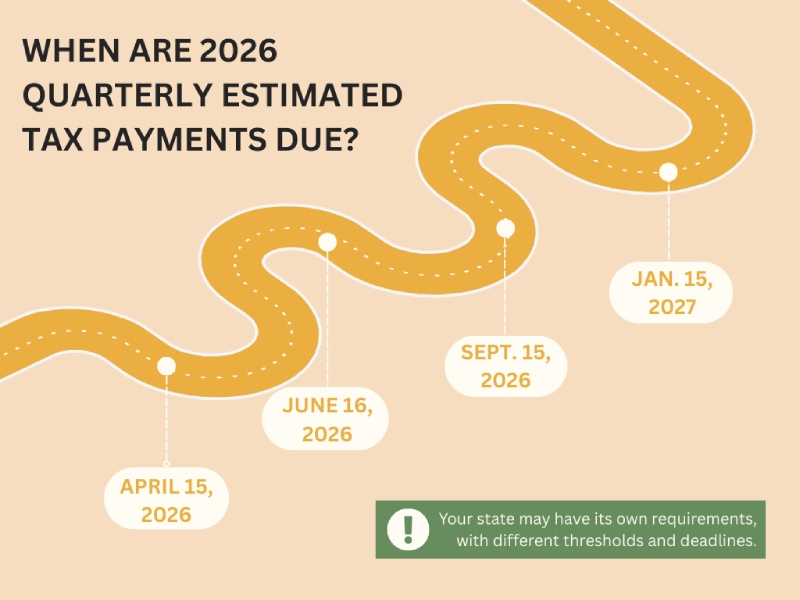
- To avoid underpayment penalties, your 2026 deadlines for quarterly payments are April 15, June 16, September 15, 2026, and January 15, 2027.
- You can generally avoid penalties by paying at least 100% of last year’s total tax (110% for high earners) or 90% of your current year’s projected tax.
- Using a clean Profit & Loss (P&L) statement each month allows you to adjust your payments based on your actual profit, protecting your cash flow during slower seasons.
When you run your own business, you are both the employer and the employee, which means the responsibility for withholding tax falls entirely on you.
If you’ve ever felt the sting of a surprise tax bill in April, it’s usually because your quarterly estimates weren’t aligned with your actual income.
And while I’m not your Rockville, MD tax pro, I am the one who manages your records and provides the clean reports they need to calculate your quarterly payments accurately.
So today, I want to show you the most organized way to handle your 2026 payments so that estimating your taxes never feels like guesswork.
Who should be paying estimated taxes?
By keeping your records up to date, I can help you determine if you meet the thresholds for paying quarterly estimated taxes:
- Your business is on track to owe $1,000 or more in federal income tax for the year, and
- Your withholding and refundable credits will cover less than 90% of this year’s tax, or less than 100% of last year’s tax (110% if last year’s adjusted gross income was over $150,000, or $75,000 if married filing separately).
If you’re self-employed (as a business owner or a gig worker), you probably meet these thresholds because no one is withholding tax on your behalf.
By looking at your net profit each month, I can flag these requirements early so you aren’t caught off guard by a penalty notice.
When are 2026 estimated payments due?
For 2026, we need to have your books ready for the following federal deadlines:
- April 15, 2026
- June 16, 2026
- September 15, 2026
- January 15, 2027 (for fourth-quarter 2026 income)
You’re required to pay as income is earned. So if you skip April and double up in June, the IRS may still assess a first-quarter penalty.
While the IRS sets these four specific dates as the final deadlines for each period, you don’t have to wait for the deadline to pay. Some business owners I work with find that making monthly payments is more manageable than four large, quarterly transfers.
This keeps your monthly cash flow steady and prevents that sticker shock every few months.
Also, remember that your state may have its own estimated tax requirements, with different thresholds and deadlines. So always check those too.
How to estimate quarterly tax payments
The right approach depends on how predictable your income is. So, we’ll need to look at your financial data to help you and your tax pro decide which of these two methods keeps your cash flow steady.
As one method, you can use last year’s total tax liability as a baseline (AKA, the Safe Harbor Approach). This works well if your business’s income is relatively stable.
For example, if your total federal tax last year was $10,000, you could send in $2,500 each quarter this year.
Under the safe harbor rule, if you pay at least:
- 100% of last year’s tax (or
- 110% if last year’s AGI exceeded $150,000),
You generally avoid underpayment penalties (even if you end up owing more when you file).
But maybe you have a seasonal business, or you do commission-based work, which makes your income less steady. You could use the Annualized Income Installment Method to estimate your quarterly tax payments.
With this method, at the end of each quarter, I run a clean Profit & Loss (P&L) statement to calculate your actual income and deductions for that specific period.
We then estimate your tax based on what you’ve actually earned so far, rather than what happened last year. This allows you to adjust your payments up or down so you aren’t overpaying during a slow quarter.
By keeping your books reconciled monthly, you have the flexibility to switch between these strategies based on how your year is actually going.
How do I make quarterly estimated tax payments?
You’ll use Form 1040-ES to calculate your payments, and I can provide the updated Profit & Loss (P&L) statements needed to fill it out accurately.
Then, to actually make the payments, you have a few options. The most commonly used is the Electronic Federal Tax Payment System (EFTPS). It’s a free service that provides a secure record of your payment history, which I can then easily reconcile against your bank statements.
You can also mail a check with that Form 1040-ES, which provides a paper trail if you prefer physical documentation. Or, you can use the IRS2Go mobile app on your phone.
Because I’m monitoring your books monthly, we don’t have to stay stuck with one number all year. If your revenue drops or your expenses spike mid-year, we can adjust your future payments to better reflect your actual profit.
Just keep in mind that your tax preparer may need to attach Form 2210 to your annual return to explain the fluctuations to the IRS. And if you overpaid by year-end, we can look at whether to request a refund or apply that credit to next year’s first quarter to get you ahead.
What happens if I don’t pay quarterly estimated taxes?
If you don’t pay enough in estimated taxes during the year, you may owe an underpayment penalty (with interest) in addition to the tax you still owe.
The penalty is calculated based on:
- The amount you underpaid
- How long the payment was underpaid
- The interest rate for that quarter (which changes quarterly)
The IRS determines the penalty using your total tax liability (your tax accrued minus credits) shown on your return.
There are some special cases where the penalty won’t apply. You won’t owe a penalty if you had no tax liability in the prior year, you were a U.S. citizen or resident alien for the full year, and the prior year covered 12 months.
You could also qualify for a waiver if you underpaid due to reasonable cause, like a casualty or disaster, retirement at age 62 or older, or disability during the current or prior year.
By keeping your monthly records accurate and up to date, we can spot potential underpayments before they turn into expensive IRS notices.
Final thoughts
If you’ve spent previous years quietly worrying about whether you are setting aside enough cash (or if you’ve been blindsided by a big tax bill in the past), I want to help you make this year different.
My goal is to get your books fully reconciled and your reports polished so you can hand them off to your tax professional with zero worries about things being handled correctly.
Once they have clean data, they can give you the final word on the exact amount to pay to protect you from penalties.
Let’s take a look at your numbers before that first deadline hits in a few weeks.
FAQs
“What happens if I missed the first quarter deadline?”
If you miss a deadline, don’t wait. The IRS calculates penalties based on how late the payment is. The sooner you get that money in, the more you minimize the interest. If you missed the April 15th date, send the payment as soon as we have your books reconciled for that period. It’s always better to be a little late than to skip it entirely.
“Do I need to pay quarterly estimates during my first year in business?”
If you expect to owe more than $1,000, yes. However, if you didn’t have a tax liability last year (maybe you were a W-2 employee and had enough withholding), you might fall under a Safe Harbor exception for your first year. I usually recommend my clients start setting aside a percentage of their profit anyway. Even if you don’t have to pay quarterly this year, you’ll still owe that tax in April, and it’s much easier to pay in small chunks than all at once.
“Can I pay my estimated taxes monthly instead of quarterly?”
Absolutely. While the IRS has four specific deadlines, they won’t complain if you pay more frequently. Paying monthly (often right after I close your books for the previous month) can make your cash flow feel much more stable. It turns a giant bill into a standard monthly operating expense.
“How do I keep track of my quarterly estimated tax payments?”
This is where clean bookkeeping is crucial. Whenever you make a payment via EFTPS or check, you should categorize it as “Federal Estimated Tax” (typically an equity draw, not an expense). When it’s time to file your annual return, I’ll provide a report for your tax preparer showing exactly how much you’ve already paid so you get full credit for every dollar.
“How do I pay quarterly taxes if I have inconsistent income?”
If you have a huge Q1 but a slow Q2, your payments should reflect that. This is why we use the Annualized Income Method. Instead of guessing or using last year’s numbers, we look at your actual net profit for the quarter. Having up-to-date books allows us to be agile so you aren’t overpaying during lean months.